







 CIJConnect Bot-enabled WhatsApp today at 4:00 PM.

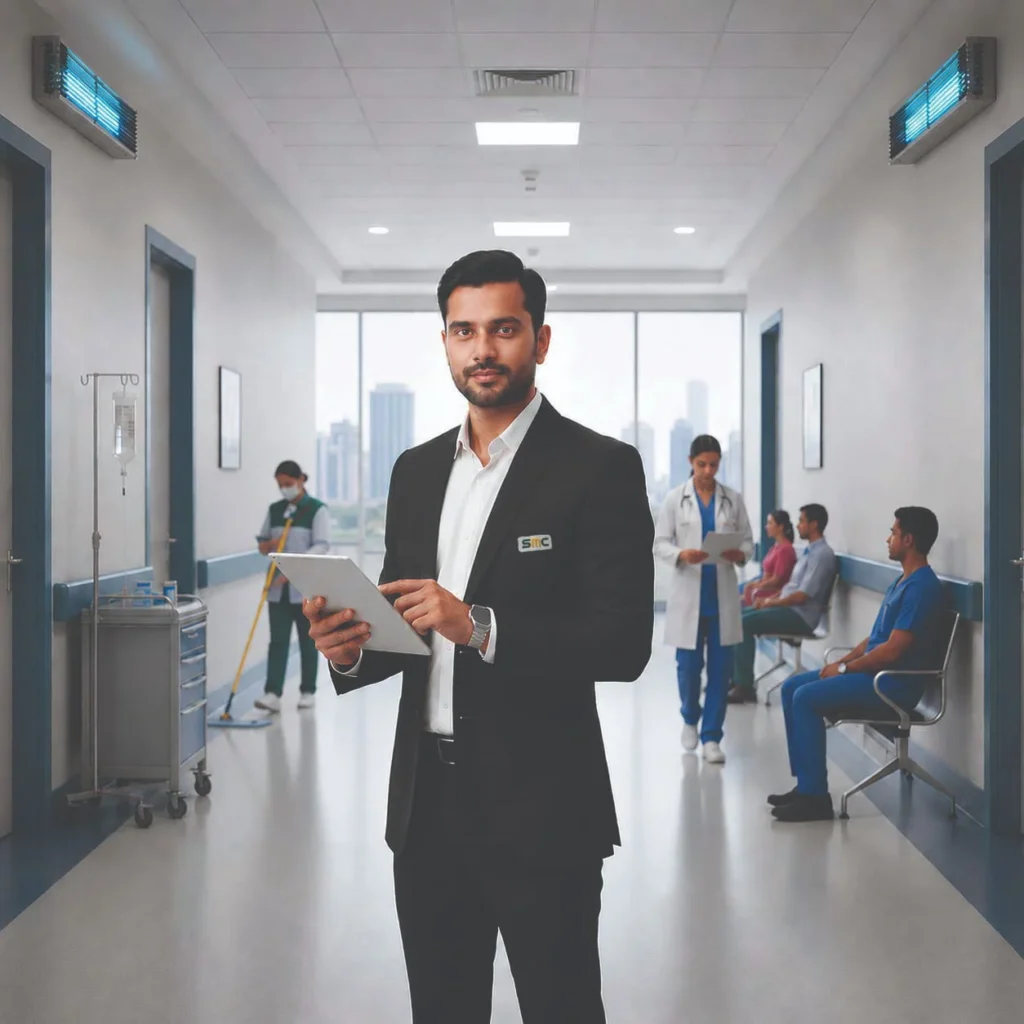
Priyanka Bane Kamble, Assistant Vice President, ESG and Healthcare Facility Strategist – under the direction of Edward D’Souza, explains how SMC Integrated Facility Management Solutions Limited is changing the standard of care at Caritas Hospital & Institute of Health Sciences, Kottayam — 271,000 sq. ft., two campuses, one uncompromising programme.
Every hospital administrator eventually confronts the same question — usually after an HAI incident, an audit finding, or a near-miss that never makes it into any report: are we actually preventing infection, or are we just cleaning?

In most Indian hospitals, the honest answer is the latter. Not because the staff aren’t working. Because the framework was never built for infection prevention. It was built for appearance. In healthcare, those are two entirely different briefs.
Caritas Hospital & Institute of Health Sciences in Kottayam decided not to wait for a forcing event. In February 2026, they brought SMC Facility Services onto two campuses — the Cardiology and Oncology blocks of their multi-speciality complex and Caritas Matha Super Speciality Hospital — covering 271,000 sq. ft. The mandate wasn’t housekeeping. It was infection control.
Everyday Use
SMC’s Smart Surface Disinfection Programme (SSDP) is reverse-engineered from NABH and JCI standards — with 60% of those guidelines embedded into daily operations. The goal isn’t to pass an inspection. It’s to protect the person in the bed, on every shift, whether an auditor is present or not.
SSDP runs on five pillars: Man, Material, Machine, Method, and Measure. At Caritas, each pillar replaced something the industry had quietly accepted as good enough.
Man: Caritas’s existing staff transitioned to SMC’s payroll — same people, now with full statutory benefits and, for many, the first structured healthcare training of their careers. Curriculum: 7-step cleaning, ICU and OT protocols, discharge room procedures, needle-stick injury response, spillage management, patient-area etiquette. They didn’t just learn to clean differently. They learned
why it matters.

Material: Cotton mops and wringer buckets were replaced with microfibre flat mops on a pre-wet system — one fresh sleeve per room, sealed after use. Colour-coded mops and dusters assign every tool to a specific zone. What touches a washroom never enters a patient room. Auto-dilution dispensers replaced spray cans, protecting patients with respiratory conditions from aerosolised chemicals. Rubbermaid janitor carts keep cleaners within their zones. On-site laundry with full IPC protocol closes the loop from first use to safe reuse.
Machine: Equipment chosen on clinical performance. Floor scrubbers in lobbies, OTs, ICUs, and the Cathlab. Single morning service replaced with morning and evening — double the intervention window.
Method: Clockwise room sequences. Dedicated discharge protocols. High-touch surfaces — bed rails, call buttons, IV stands, light switches — as a non-negotiable daily priority. Glow Germ assessments. Deep cleans for critical areas. International standards, applied without exception.
Measure: Three feedback layers: SMC supervisor inspections via IQMS barcode scanning, real-time nursing staff input, and patient satisfaction scores. Monthly management dashboards give leadership a clear, honest view of FM performance. Because what doesn’t get scored doesn’t get better.
“Traditional FM manages people; Smart FM measures impact, accountability and operational performance”
Technology Use
IQMS — Intelligent Quality Management System — turns every inspection into a timestamped data point. No clipboards. No subjectivity. Hospital leadership sees performance as numbers, not impressions.
iPorter is a beacon-based dispatch platform — the Uber model applied to patient attendant services. Bed baths, shaving, bedpan assistance, patient transport: matched to available staff on demand, in real time. Manpower goes where it’s needed. Patients stop waiting.
Sustainability Method
Pre-wet systems cut water use per clean. Auto-dilution eliminates chemical waste at source. Reusable microfibre reduces landfill load. Demand-based staffing cuts idle deployment. Full statutory compliance advances the hospital’s own ESG social pillar. SMC’s sustainability contribution isn’t a separate initiative — it’s what happens when the job is done correctly.