








 CIJConnect Bot-enabled WhatsApp today at 4:00 PM.
 Why do ill people who visit a hospital for the treatment of an infection sometimes return with an entirely different, more dangerous infection? Why do perfectly healthy relatives of patients in hospital become casualties to infection themselves? The reason behind this is a group of diseases called hospital-acquired infections.
The World Health Organisation defines this as an infection acquired in hospital by a patient who was admitted for a reason other than that infection; an infection occurring in a patient in a hospital or other healthcare facility in whom the infection was not present or incubating at the time of admission. This includes infections acquired in the hospital but appearing after discharge, and also occupational infections among staff of the facility.

These infections can be contracted from contaminated medical equipment, unclean hospital rooms, and other patients and healthcare staff themselves, and can be fatal. A study conducted across 20 Indian cities over 10 years involving 236,700 ICU patients and 970,713 hospital bed-days revealed infection rates of 5.1 central intravenous line-associated bloodstream infections/1,000 central line-days, 9.4 cases of ventilator-associated pneumonia/1,000 mechanical ventilator-days, and 2.1 catheter-associated urinary tract infections/1,000 urinary catheter-days. These infections are more difficult to treat than those contracted outside the hospital, but fortunately, they can be prevented.
Dr Sweta Shah, Consultant – Microbiology & Infection Prevention at Mumbai’s Kokilaben Dhirubhai Ambani Hospital gives us an insider’s perspective on how this can be achieved, and what machines, chemicals and techniques are used at her hospital:
Standards for Hospital Infection Control
 Our hospital follows guidelines from the Center for Disease Control (USA), Infectious Diseases Society of America, the Association for Professionals in Infection Control, and Hospital Infection Society (India). These guidelines provide a framework for each hospital’s infection control program, but the details vary from center to center, depending upon the type of patient, type and infrastructure of the medical unit.
For example, patients in the Intensive Care Unit are more critical and more prone to acquiring hospital-associated infections than patients in a ward, and hence extra efforts and care are needed for prevention of infection among such highrisk patients. In labour rooms, infection control efforts are generally directed towards prevention of infection among new-borns.
However, the basic framework of the infection prevention methodology in every area remains the same, which will include hand hygiene, care of all the intravenous lines and/or devices used for the assistance of patient and environmental disinfection, apart from the appropriate use of preventive, broad-spectrum antibiotics.
Rates of hospital acquired illnesses
The rates of hospital-acquired illnesses are declining, since awareness about them and their prevention has increased. This allows us to do more critical, high-end work like bone marrow transplants, which require a level of sterility that was previously unachievable — to prevent posttransplant infections. However, the path isn’t straight, and unseen challenges are a common occurrence. The rates of hospitalassociated infections are still higher in India as compared to various international standards. The rate in India varies among types of hospital set-ups.
Although the rates of hospitalassociated infection may be reducing, the infections caused by antibiotic-resistant bacteria are increasing. These infections are often difficult to treat.
How infection control techniques can vary based on the size of the hospital
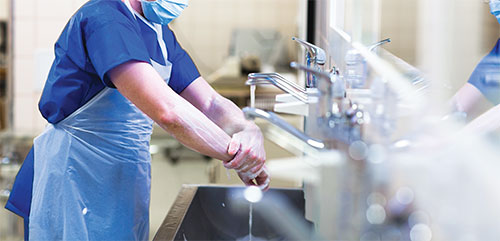 Infection control techniques should remain exactly the same between hospitals, irrespective of the size of the hospital or the number of the patients. Often, it is a subjective phenomenon and dependent upon the management of the hospital. It often differs depending upon the type of the hospital e.g. the practices among neonatal intensive care units are generally far better than adult ICUs. By and large, implementation of infection control practices in the private sector is often better than in public hospitals.
Patients with cancer have lower immunity. Patients on chemotherapy often get new infections or their old infections get reactivated, since chemotherapy can reduce white blood cells, which are responsible for battling infections. Thus, such patients need to be handled with the most sterile techniques. For example, drug preparation for such cases is done in biosafety cabinets and only sterile gloves are used to handle their vascular lines.
[box type=”shadow” ] Hospital managements have come to realise that hospital-associated infections can increase the length of stay of a patient, causing more burden on the hospital, which can also lead to increased resistance to antimicrobial drugs, and can prove catastrophic to the ‘image’ of the hospital.[/box]
Patients with traumatic injuries come to hospital with wounds contaminated by microorganisms from the external environment. The chances of bacteria and fungi from soil causing infections of the wound are very high. Accidents are one of the important causative agents of gas gangrene. Thus, source control for patient and environmental cleaning here is more important.